Southern California occupies a rare place on the map. Climatologists classify it alongside the Mediterranean coast of southern France, coastal Italy, and parts of Spain and Greece — one of only five regions on earth with a true Mediterranean climate. Long, sun-drenched summers. Mild, brief winters. An outdoor season that doesn’t really end. In the great estates of Tuscany and Provence, this climate gave rise to centuries of outdoor living as a way of life — covered loggias, stone terraces, kitchens open to the air, and gathering spaces designed to blur the line between inside and out.
In Beverly Hills and Bel Air, in the foothills above Pasadena and La Cañada Flintridge, in the canyons of Malibu and the gracious estates of San Marino, homeowners are building that same tradition into their properties. Not as a trend, and not as a seasonal feature — but as a permanent, considered extension of how they live. And when an outdoor kitchen or entertaining space is conceived and constructed with that intention, it demands the same level of planning, expertise, and craft as any other part of the home.
Infrastructure Is the Foundation of Everything
The most important decisions in any outdoor entertaining space happen before the first stone is laid or the first appliance is ordered. Infrastructure — the unglamorous network of gas lines, electrical conduit, plumbing, and drainage that makes everything function — is where the difference between a truly built outdoor kitchen and a decorative approximation is made.
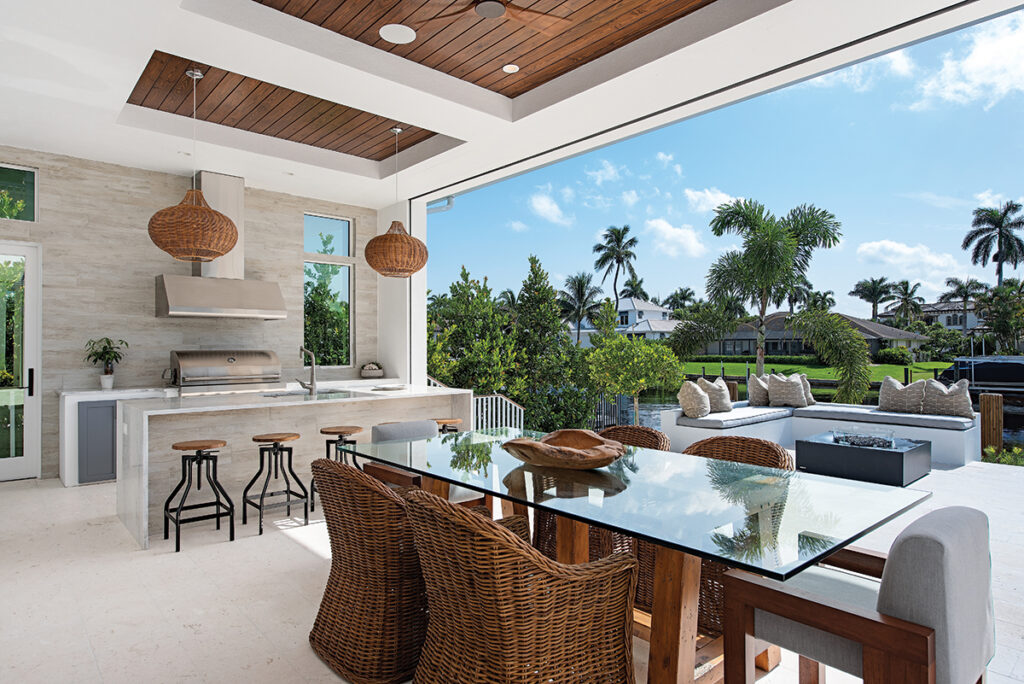
A fully equipped outdoor kitchen in a Southern California luxury home might include a professional-grade grill, a wood-fired pizza oven, dual side burners, a built-in smoker, a dedicated refrigerator and wine cooler, an ice maker, a prep sink with hot and cold water, and a dishwasher. Each of these requires a planned connection. Gas lines must be sized correctly for the combined BTU load of every appliance running simultaneously. Electrical circuits must be dedicated, weatherproof, and code-compliant — and in California, increasingly, they must be planned with future EV charging and solar integration in mind. Water supply and drainage must be routed intelligently, with consideration for freeze protection on the rare cold nights the region does experience.
Drainage is often the element that gets underestimated. Outdoor kitchens are washed down frequently, and Southern California does receive meaningful rainfall during winter months. Without a properly engineered drainage plan, water can pool, penetrate hardscape, undermine foundations, and damage cabinetry. This is planning work that happens at the design stage, in close coordination with the project’s civil engineer and architect — and it’s the kind of work that invisible afterward, when everything simply performs.
Choosing Materials That Perform as Well as They Look
The visual palette of a luxury outdoor kitchen is immediately apparent: natural stone, stainless steel, teak and ipe, large-format porcelain tile. What is less apparent — but equally important — is how each of these materials behaves in a Southern California outdoor environment, and what it takes to specify and install them correctly.
Natural stone is perhaps the defining material of the outdoor spaces we build most often in this region. Limestone, travertine, quartzite, and bluestone all bring a depth and warmth that manufactured materials cannot replicate. But stone used outdoors must be selected with an understanding of its porosity, its slip resistance when wet, and its thermal behavior under sustained sun exposure. Installation technique matters enormously — how stone is cut, coursed, and finished at the edges and transitions is what separates a surface that ages gracefully from one that begins to show its seams.
Stainless steel — the grills, burners, appliance housings, and drawers that form the working core of an outdoor kitchen — Not all stainless performs equally in an outdoor environment, and selecting appliances built for outdoor exposure — from reputable manufacturers who prioritize material quality and durability — is a distinction that shows up clearly over time.
Wood — teak, ipe, and similar hardwoods — brings warmth to outdoor spaces that stone and steel alone cannot provide, and in Southern California’s forgiving climate, these materials perform exceptionally well when properly finished and maintained. The key is selecting species with the right density and oil content for outdoor exposure, and detailing connections and fasteners to allow for the natural movement of wood without cracking or splitting.
Large-format porcelain tile has become increasingly popular in luxury outdoor applications, and for good reason. Modern through-body porcelain is extraordinarily durable, UV-stable, and available in formats and finishes that rival natural stone. Its success depends on proper substrate preparation — outdoor tile installations require reinforced, crack-isolated substrates and the right mortar system to perform through years of thermal cycling.
Covered Structures: More Than Shade
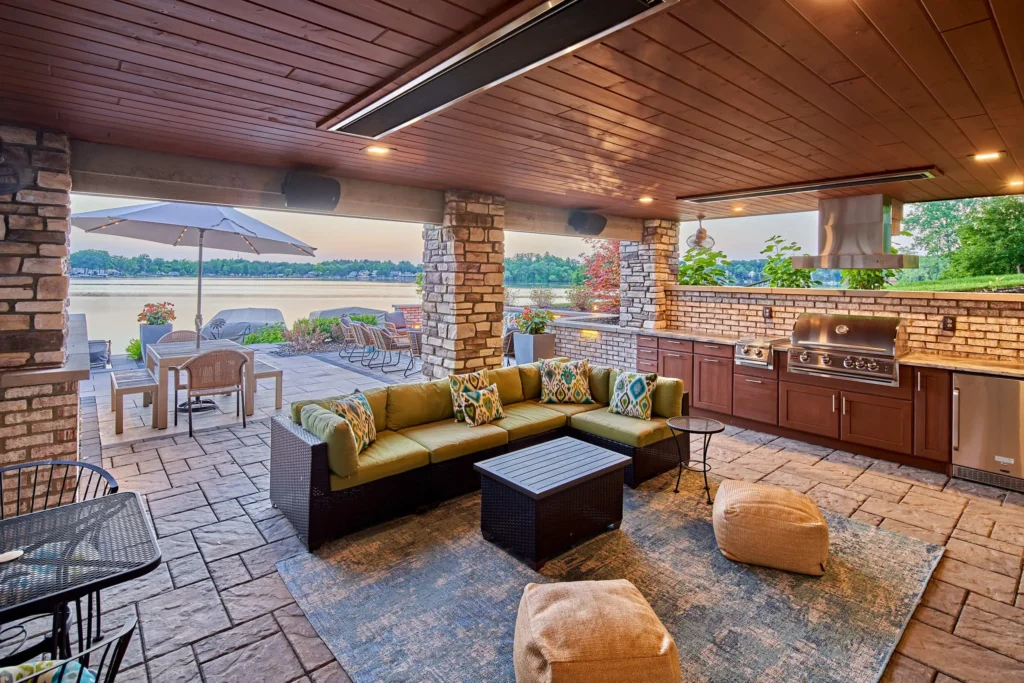
The most transformative investment in any outdoor entertaining space is a thoughtfully designed covered structure. A pergola, a loggia, a full roofed outdoor room — each creates a different experience and carries very different construction implications.
A simple pergola with open rafters provides filtered shade and a sense of enclosure without fully covering the space. It’s the lightest structural intervention, but even here, the details matter: post footings must be engineered for the loads involved, and in Southern California’s seismic environment, and wind — whose velocity and direction vary considerably across Southern California’s microclimates — places real demands on how a pergola is anchored and how its connections are detailed.
A loggia — the covered, colonnaded passage that has been a feature of Mediterranean architecture for centuries — brings full weather protection while maintaining a direct connection to the outdoors. When a loggia is attached to the main house, it becomes part of the home’s structural system, and its design must be coordinated with the existing building’s framing, waterproofing, and roof drainage. Getting this connection right is critical in the overall performance of both structures, loggia and house.
A fully enclosed outdoor room — with a solid roof, finished ceiling, built-in heaters, and operable screens or glass panels — is the most ambitious and most rewarding option. These spaces extend usable square footage meaningfully, and when designed with the right materials and mechanical systems, they function comfortably year-round. They also require building permits, structural engineering, and the full coordination of a construction team that understands how to execute the construction seamlessly.
Extending the Home’s Architectural Language
The outdoor entertaining spaces that feel most extraordinary are the ones that feel inevitable — as though they were always part of the home, not added to it. Achieving that quality requires a deliberate effort to extend the home’s existing architectural language outward: matching or complementing the exterior materials, carrying the roofline details into covered structures, aligning stone profiles and finish elevations with the interior.
This is fundamentally a design and construction coordination challenge. It requires close collaboration between the architect of record, the landscape architect or designer, and the builder — conversations that happen at the drawing stage, not during construction. When we work on outdoor entertaining spaces as part of a new custom home project in Pacific Palisades or Arcadia or Brentwood, these conversations begin at the earliest design meetings. The orientation of the site, and the way the sun moves across it through the day and across the seasons, should inform where an outdoor kitchen is positioned, where shade structures are placed, and where dining and lounge areas are located — all of which is integral to the overall usability and enjoyment of the finished space.
The goal is always the same — an outdoor space that feels like an expression of the home, not an appendage to it.
Lighting, Audio, and Smart Systems: Design In, Don’t Retrofit
The evening hours are when Southern California outdoor spaces truly come into their own. After the sun drops behind the hills and the air cools, a well-lit outdoor kitchen and dining terrace becomes one of the most pleasurable environments a home can offer. Achieving that experience requires lighting that was planned as part of the construction, not added afterward.
Architectural outdoor lighting — in-grade uplights, soffit-mounted fixtures, integrated step lights, landscape lighting along planting beds — requires conduit and junction boxes to be in place before hardscape and planting are completed. Retrofitting lighting into finished stonework or mature planting is expensive and rarely achieves the same result. The same logic applies to audio: in-ground or in-wall speakers, subwoofers, and wiring for outdoor televisions or projection systems all need to be roughed in during construction.
Smart home integration is increasingly expected in luxury outdoor spaces — the ability to control lighting scenes, audio zones, automated shades or screens, and outdoor heaters from a single interface or through voice commands. Planning for this during construction means the low-voltage infrastructure is in place from the start, and the system can be expanded over time without invasive work. Artin’s experience coordinating these systems from the ground up — working directly with technology integrators during the construction phase — ensures that the finished system performs seamlessly rather than feeling like a collection of afterthoughts.
Building for How You Actually Live
The finest outdoor entertaining spaces in Southern California aren’t designed around a catalog or a trend. They’re designed around the specific way a family lives — how they cook, how they gather, whether evenings are intimate or expansive, whether the space will host quiet family dinners or large celebrations under the stars.
Getting that right requires a builder who listens before they build, who understands the construction complexity behind the vision, and who can partner with the design team to bring everything together with precision. At Triton Engineering Contractors, outdoor entertaining spaces are among the projects we find most rewarding — they combine genuine technical challenge with the direct, visible pleasure they bring to the people who use them every day.
We’d love to talk with you about how an outdoor kitchen and gathering area would enhance your overall experience of your custom home — and how it can bring so much more to your daily life than simply a backyard.