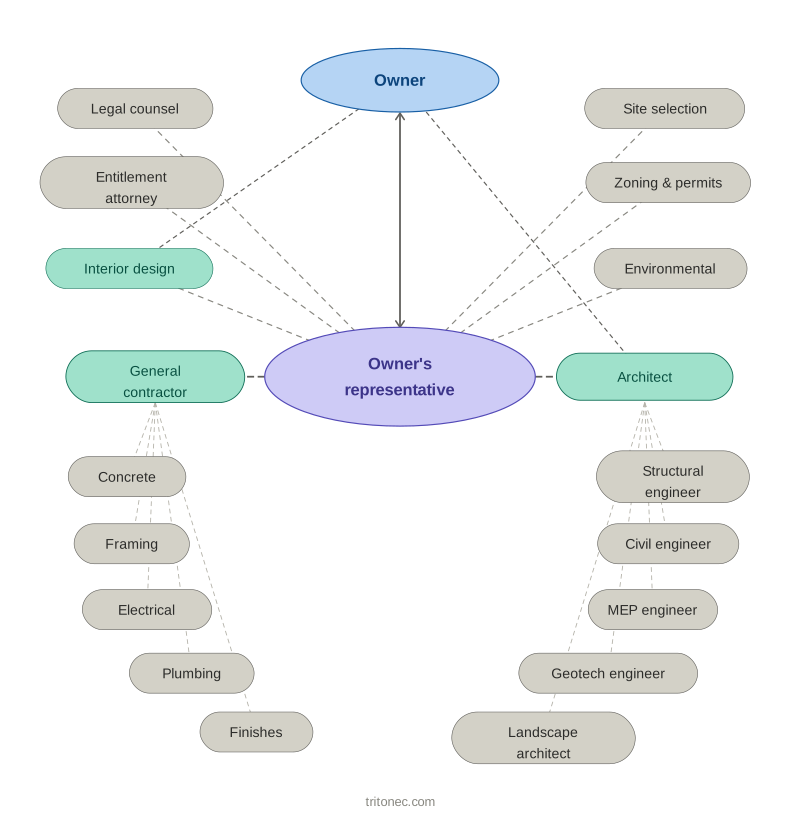
Building a custom home is one of the most significant financial decisions a person can make. It’s also one of the most complex processes most homeowners will ever navigate — and it keeps getting more complex every year. An owner’s representative is the professional brought in to provide independent, unbiased oversight of that process, managing the project on the homeowner’s behalf and making sure their interests are clearly represented at every stage.
What makes the role distinct is its independence. While every other professional on a custom home project is focused on executing their specific scope — the architect on design, the contractor on construction, the engineers and consultants on their respective systems — the owner’s representative is focused on the whole picture. That broad, unbiased oversight is what allows them to concentrate on objective coordination, clear communication, and a consistent focus on the homeowner’s goals across every phase of the project. It’s a collaborative role, not an adversarial one. The best project outcomes happen when everyone on the team is working well together, and one of the owner’s representative’s core functions is creating exactly that environment.
Why Custom Home Construction Has Become More Demanding Than Ever
The custom home projects being built today bear little resemblance to what was considered a high-end residential build even fifteen years ago. The scope of what homeowners expect, the complexity of the systems involved, and the regulatory environment surrounding construction have all changed substantially — and they continue to evolve.
Energy codes have become significantly more rigorous across most of the country. Building departments in many markets have longer review timelines and more detailed submission requirements than they did a decade ago. Fire-resistant construction standards have expanded in response to changing risk conditions in many regions. And the technology systems now standard in luxury homes — integrated automation, whole-home networking, distributed audio, smart HVAC, EV charging infrastructure — require dedicated pre-construction planning and multi-trade coordination that barely existed as a formal discipline ten years ago.
The composition of a project team has grown accordingly. A serious custom home build today regularly involves an architect, structural and civil engineers, a geotechnical consultant, an MEP designer, a landscape architect, a low-voltage and smart home integrator, an interior designer, a general contractor, and fifteen to twenty-five subcontractor scopes depending on the complexity of the project. Each of those parties is a specialist in their domain. None of them is responsible for making sure all those domains are working together in alignment with the homeowner’s goals. That is the owner’s representative’s function — and it’s a function that matters more today than it ever has.
What Does an Owner’s Representative Actually Do?
The owner’s representative manages the full process of a custom home project on behalf of the owner. That scope covers every phase — land acquisition, pre-design, design, permitting and entitlements, construction, and closeout — and includes coordination with specialty consultants such as entitlement attorneys, land use advisors, and other third-party experts the project requires — and includes the coordination, oversight, and decision support that keeps a complex project moving in the right direction.
Before design begins, the OR helps identify and assemble a design team that is the right fit for the project — the right architect, the right engineers, and the right specialty consultants for what is actually being built. Every project has its own character, complexity, and technical demands, and matching those requirements to the right professionals from the start sets the entire project up for success. The OR evaluates candidates based on their experience with comparable projects, their availability, and how well they are likely to collaborate within the team. Getting the right people in the right seats early is one of the most impactful things an owner’s representative does — and one of the things that is hardest to course-correct once the project is underway.
During design, the owner’s representative participates in coordination meetings alongside the architect and design team, primarily tracking how evolving design decisions affect the project’s budget and schedule. As the design develops, the OR helps the owner understand the cost and timeline implications of key choices — keeping those conversations current rather than letting them accumulate into a surprise at the end of design. The OR’s role here is to support the process, not to direct it. Design leadership belongs to the architect and the design team. The OR’s contribution is making sure the owner stays informed and that the project’s financial and schedule realities stay visible throughout.
During construction, the OR manages the project schedule, reviews contractor pay applications, monitors the quality of work in place, and administers the change order process. Change orders are a normal part of any custom home build. What matters is whether they are clearly documented, fairly priced, and fully understood by the homeowner before they are approved. Without independent oversight, change orders are one of the most common sources of budget overruns on residential projects.
At closeout, the owner’s representative ensures that punch list items are resolved completely, that building systems are properly commissioned and explained to the homeowner, and that all warranty documentation and as-built drawings are delivered before the project team disperses.
One Role, One Focus: Representing the Owner
This is the question that gets to the heart of why owner’s representatives exist. On a custom home project, every professional is serving a legitimate purpose — but each of them also has their own professional interests and relationships to manage.
Every professional on a custom home project is focused on delivering their best work within their specific domain — and that specialization is exactly what makes a high-quality project possible. But no single team member is positioned to manage the full picture on the owner’s behalf. Each is appropriately focused on their own scope and deliverables. The owner’s representative fills that gap: an independent, unbiased presence whose focus is the overall success of the project and making sure the owner’s interests are clearly represented at every stage of a complex, multi-party process.
The owner’s representative occupies a unique position entirely. Their fee is not tied to the size of the construction contract and with this separation they are able to serve the owner unbiasedly, eliminating all conflict of interest which would be tied to the project cost. Their professional success depends on one outcome: whether the project was delivered the way the homeowner intended, at the quality the homeowner expected, with the transparency the homeowner deserved throughout the process.
Throughout the project, the owner’s representative serves as the owner’s informed point of contact — synthesizing information from the full project team, tracking progress across all phases, and presenting the owner with clear, organized updates. When decisions arise, and meaningful ones come up regularly on any complex project, the owner receives them with the context needed to make them confidently. The OR’s role is to make sure nothing significant reaches the owner without adequate background, and that the owner’s direction is clearly communicated back to the team. That kind of structured, transparent communication is what keeps a complex project feeling manageable from the owner’s side.
Does an Owner’s Representative Get in the Way of the Design Team?
This is a common concern, and it’s worth addressing directly. The assumption is that adding another party to the project creates friction — more approvals, more meetings, more communication layers between the architect and the client.
In practice, experienced architects and designers report the opposite. When a skilled owner’s representative is on the team, the design professionals can focus on design. The logistical and administrative load that would otherwise fall on the architect — tracking consultant coordination, managing the client’s schedule, fielding questions from the contractor — shifts to the OR. That frees the design team to do the work they were engaged to do.
There is also a decision-making benefit. Owners are highly capable in their own professional domains, but construction decisions are often technical and unfamiliar. An owner’s representative contextualizes those decisions — here is what this costs, here is how it affects the schedule, here is the recommendation — in a way that builds confidence and generates momentum. Architects and designers frequently note that their clients make decisions more efficiently when a trusted OR is helping frame the choices. The result is a project that moves faster and with less friction for everyone involved.
This dynamic is why many of the most experienced design professionals actively prefer to work on projects that have an owner’s representative in place.
When Is the Right Time to Hire an Owner’s Representative?
The answer is consistent across the industry: as early as possible, and ideally before the design team is selected.
The owner’s representative delivers the most value during the phases when the project’s foundation is being established — when team selection decisions are being made, when contracts are being negotiated, and when the project budget is being built. These early decisions shape everything that follows. A budget built before the scope is properly defined will almost always come under pressure during construction. A contract signed without adequate scope detail creates the grey areas that generate expensive disputes. An architect or contractor selected without rigorous evaluation may not be the right fit for what the project actually requires.
Bringing an owner’s representative in after construction begins is far better than not having one at all. Even when an owner’s representative is brought in after a project is already underway, their impact is immediate. They can quickly assess the current state of the project, identify where attention is needed, and bring structure and clarity to a process that may have grown complex without dedicated oversight. There is no wrong time to have an independent advocate in your corner — and the value of that advocacy compounds from the moment they step in.
For homeowners building in a market where they don’t live, or managing a project from a different city or state, early engagement is especially important. The owner’s representative is the consistent professional presence on the project when the Owner cannot be there in person. That continuity — through design, permitting, and construction — is something that cannot be replicated by periodic visits or remote check-ins.
What Good Owner’s Representative Work Looks Like in Practice
A well-managed custom home project feels different from the homeowner’s side. Information is organized and delivered consistently. Problems are resolved at the project level before they reach the homeowner as crises. When a decision is required, it arrives with the context needed to make it well — not as a technical dispute requiring an immediate answer without adequate background.
The homeowner’s role in a well-run project is to make the meaningful decisions about their vision: the design direction, the materials, the spaces that define how they will live in it. The operational complexity — the contracts, the schedules, the trade coordination, the change orders, the inspections — is managed by the people whose professional focus is devoted to exactly that.
At Triton Engineering Contractors, our team brings a background in commercial and multifamily construction to luxury residential work. That experience — managing complex multi-trade projects at scale, with rigorous document control and schedule discipline — informs how we approach every custom home project. We serve as owner’s representative on projects where another firm is the builder of record, and we have extensive hands-on building experience, which means we understand construction from the inside out. If you are planning a custom home and want to understand what the right level of oversight looks like for your project, we would welcome the conversation. Reach out here.
Key Takeaways
- An owner’s representative works exclusively for the homeowner and is the only professional on the project team without competing interests or relationships.
- Custom home construction has grown substantially more complex over the past decade — more specialists, more demanding regulatory environments, more sophisticated technology systems, and longer permitting timelines all contribute to the need for dedicated professional oversight.
- The OR manages the full project process: smart land acquisition, team selection, contract review, design coordination, budget management, construction oversight, and closeout.
- Architects and designers consistently find that projects with a skilled owner’s rep run more smoothly — better decisions, faster approvals, less administrative friction.
- The right time to engage an owner’s representative is at the very beginning — ideally before a property is acquired. Early involvement in the land acquisition process allows the OR to help evaluate the site’s feasibility, constraints, and development potential before a commitment is made. From there, the OR helps assemble the right design team and ensures the project is structured correctly from day one.
Frequently Asked Questions
What is an owner’s representative on a custom home project? An owner’s representative is a professional hired by the owner to manage and advocate for their interests throughout every phase of a construction project. They coordinate the project team, oversee the general contractor, manage budget and schedule, and ensure the owner has the information they need to make well-informed decisions. Their role is a dedicated, independent one — focused entirely on the owner’s goals while working collaboratively alongside the full project team.
Do I need an owner’s representative if I already have a good architect? The roles serve different functions. An architect is responsible for the design of the home. An owner’s representative manages the entire project — budget, schedule, contractor oversight, consultant coordination, and decision support — across all phases. The two roles are complementary, and most experienced architects welcome a skilled owner’s rep on the team because it allows them to focus on design rather than project administration.
Can an owner’s representative help with land acquisition? Yes — and getting involved at this stage is one of the most valuable things an owner’s representative can do. Before a property is purchased, the OR can help evaluate the site’s development potential, identify zoning restrictions, assess feasibility for the intended project, and flag conditions that could affect the scope, timeline, or complexity of what gets built there. Making an informed land acquisition decision is the foundation of a well-structured project, and the OR’s involvement at this stage helps ensure the owner is fully informed before any commitment is made.
When should I hire an owner’s representative for a custom home project? Before the design team is selected, ideally. Early engagement allows the OR to help structure the team, the contracts, and the project budget before any of those decisions become difficult to change. That said, engaging an owner’s representative at any stage of a project brings immediate value — there is no point in the process where having an independent advocate working on your behalf isn’t worthwhile.
Why are more homeowners hiring owner’s representatives on custom home projects today? Because the projects themselves have become genuinely more complex. Tighter building codes, expanded technology systems, larger and more specialized project teams, and longer permitting timelines have all raised the management demands on a serious custom home build. The owner’s representative role has been standard in commercial construction for decades — the high-end residential market has recognized the same need.